Joy Hakanson Colby Signs the Beam at the Scarab Club.
September 2008
Gilda Snowden, David Barr, Dennis Nawrocki, Gary Eilenko, Charles McGee

Lester Johnson, Joy Colby

Sarah Colby, Bob Wilbert, Joy, Treena Erickson


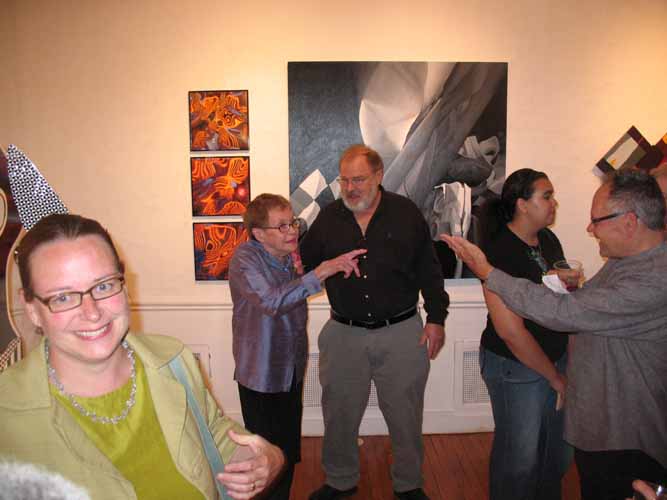
Sarah Colby, Joy, David Barr, Woman, Dennis Nawrocki
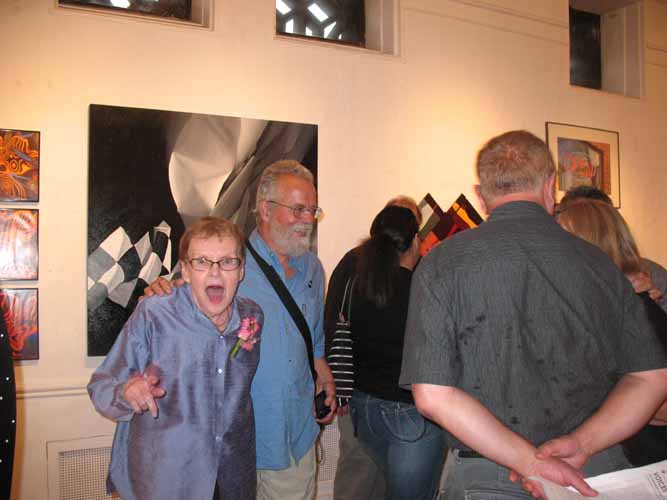
Joy, Jim Pallas

Joy, Jim and Janet Pallas

Lester Johnson, Joy and man.

woman, Joy, Sarah Colby
Scarab Club pays tribute to art writer Joy Hakanson Colby
Michael H. Hodges / The Detroit News
Those lucky enough to squeeze into
Detroit's venerable old Scarab
Club tonight will be treated to a dazzling new show, "Voices," that
comprises a virtual who's who of Michigan's top artists, including
many, like Charles McGee, who rarely submit work for juried
exhibitions."Voices," up through Oct. 12, was curated
by Joy
Hakanson Colby, the longtime Detroit News art critic who retired in
2006. In many ways, the show represents the collective gratitude of the
local art community to a woman who for 50-plus years championed the
work coming out of Detroit.Indeed, in recognition of her
influence, the club -- founded in 1907 by Detroit's artistic elite --
has asked Colby to sign one of the ceiling beams in their upstairs
hall, an honor reserved for artistic superstars the likes of Diego
Rivera and John Sloan, Cranbrook architect Eliel Saarinen and, more
recently, novelist Elmore Leonard.The signing will take place at 7:30
tonight -- less than 24 hours before Colby, who lost her husband Ray
last January, gets on a plane to move to St. Louis to be closer to two
of her three daughters.
"One of the things I'm so happy about
with the beam-signing is that Joy is moving to St. Louis," says club
gallery director Treena Flannery Ericson. "This is the last opportunity
for people to celebrate her and let her know how much she's meant to
Detroit."
For her part, Colby -- a diminutive woman
with an unfailingly hip fashion sense -- says she was astonished at
being asked.
"I
was amazed," she said on Wednesday morning, sitting in the club's airy
gallery space while artist McGee worked on hanging the show.
"I mean, people like Diego Rivera and
Saarinen are up there." Colby shakes her head. "It's just a great
honor."
No
less an honor, she says, was getting the opportunity to choose among
hundreds of works that poured in once artists knew that Colby would be
curating. Ericson isn't sure of the exact number of entries, but says
it was more than 300 -- astonishing for a show that was only announced
a couple months ago, and pulled together in record time.
The
big names include not just McGee, but Gilda Snowden, Jon Strand,
Jocelyn Rainey and Lester Johnson -- as well as some complete newcomers
like Lisa Marie Rodriguez, a student at Wayne State University.
The
show's delights are considerable. Worth a special trip are photographer
Bruce Giffin's powerful "Joe Jones," a study of an old man's face in
black and white; Russell Dunbar's realist painting of an abandoned
Brush Park mansion, "Demolished by Neglect"; and Gerald C. Moore's
beautiful, nearly vertigo-inducing oil, "Bryce Snow Storm."
Much
of what Colby picked is somber and profound, like Brandon Burke's
paired portraits of a man and woman, "Gerry/Shanna," which -- hung
side-by-side -- evoke something of the grim majesty of the
pitchfork-toting farmer and wife in Grant Wood's "American Gothic."
Happily, not all is serious.
Taking
a reporter around the hall, Colby points to Jud Coveyou's "Gizmo," a
tongue-in-cheek painting in which a man and cat appear to tumble
multiple times across the same canvas, a bit like film frames from some
madcap movie comedy.
"That," Colby says with satisfaction, "is
a scream."
And she can't say enough about McGee's
aluminum sculpture, "United We Stand," comprises seven people-like
shapes.
Her verdict? "Charles is simply amazing."
It's a characterization many apply to
Colby herself.
Artist Gilda Snowden says that at the dawn
of her career, nothing meant more to her than her very first Joy Colby
review.
"It
was more important than getting my master's degree," says Snowden, now
the chair of fine arts at the College for Creative Studies, "because I
could take it home and show my parents and say, 'See? I was in the
paper!'"
Colby started her career at The Detroit
News in 1946.
Typical of that era, she was immediately shunted into the Society
section, and in short order became beauty editor.
Yet, it was under the rubric of "beauty"
that the Wayne State art grad was able to start sneaking art stories
into the paper.
Colby
calls her stint as beauty editor "such fun -- I once dyed a girl's hair
green for a photo shoot. And I did a silent interview with Harpo Marx.
He was just a scream, except for being such a letch."
He invited Colby to dinner, but sensibly,
perhaps, she declined.
Of
greater moment were the articles Colby wrote with Detroit News staff
writer Susan R. Pollack in 1983 exposing the freewheeling spending
habits of former Detroit Institute of Arts director Frederick J.
Cummings -- articles which triggered an audit by the city of Detroit
and were widely seen as prompting Cummings' abrupt resignation later
that year.
Colby was no pushover, artists say.
"She was tough," says Jef Bourgeau, artist
and director of Pontiac's Museum of New Art.
"Even
if you were a friend," he says, "she'd write a bad review if she felt
it deserved it. But you appreciated the honesty. And Joy was never
mean-spirited."
DIA curator of European modern art MaryAnn
Wilkinson says Colby fought very hard to keep art front and center in
the paper, an uphill battle even in the best of times.
"There's really been nobody like her
since," Wilkinson says. "Plus, she really understands artists."
Ericson agrees.
"She
wasn't just a critic, but a tireless proponent of the arts in Detroit,"
Ericson says. "Her career made such a difference for so many artists
that she simply had to be up there on a beam."
Addendum; January 2010.

My sister Sarah and I laugh about how tiny and frail Joy looks but then she floors us with her frank, hardboiled humor.
She's a force of nature....
A few months ago, a local gallery brought Carey Loren from the Bookbeat for a "Destroy All Monsters show. Carey was delighted to see Joy again and it gave her quite the boost being around a young, hip crowd here who showed interest in an interesting part of the Detroit art scene from decades ago."